Overview
The Catholic Village Framework
The "Village Model" is not a mere real estate development — it is a strategic socio-economic operating system designed to restore Catholic social order through the intentional engineering of the built environment. Rooted in subsidiarity, stewardship, and the Southern Agrarian tradition, this framework offers a universal template for socio-economic sovereignty: adaptable from a 200-acre rural model to town-center revitalizations and urban guild systems.
This Master Development Plan is organized into fifteen sections, each addressing a distinct dimension of village life — from the philosophical foundation and spatial strategy to governance, economy, spiritual life, and phased implementation. Select any section below to begin.
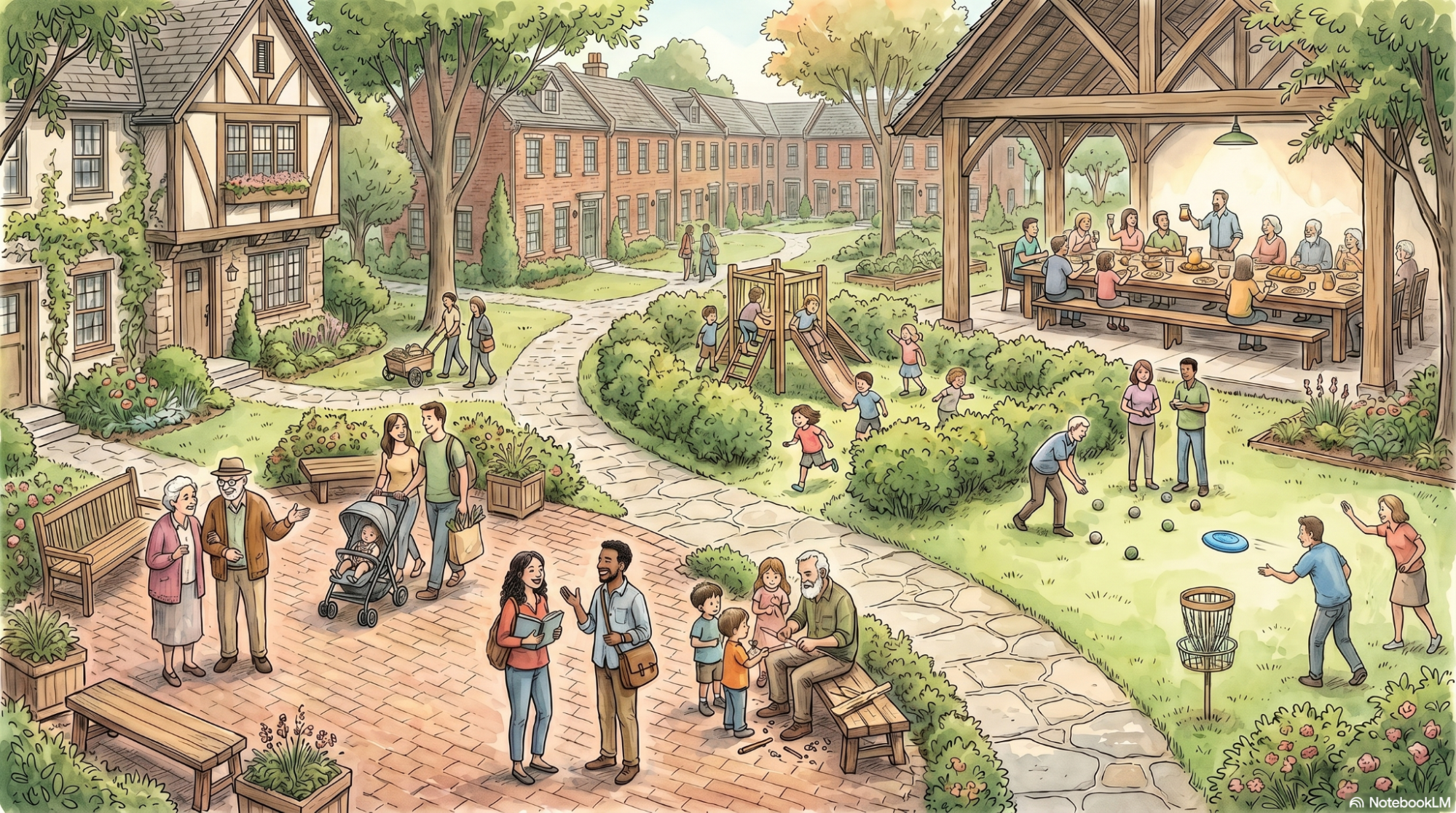
The Catholic Village — a sovereign community designed for human flourishing
Philosophical Foundation
The intellectual and moral basis for the Village Model, grounded in subsidiarity, stewardship, and the Southern Agrarian tradition.
Section 2Spatial Strategy
The 200-acre master layout using the 80/20 rule: 160 acres of conservation and production shielding a 40-acre developed footprint.
Section 3Residential Core
Architectural cluster types — Singles Quads, Family Crescent, and Retiree Cluster — designed for spontaneous social interaction and shared infrastructure.
Section 4Civic Engine
The Commons Building, Workshop, General Store PMA, and Village Library that transform a collection of houses into a functional economic unit.
Section 5Ecological Management
Regenerative farming, a 4-acre lake, and 40 acres of managed woodland that provide primary insurance against supply chain volatility.
Section 6Institutional Governance
The three-tier covenantal structure — Village Council, Parish, National Association — with asset protection through cooperative land tenure.
Section 7Education & Formation
A communal, vocationally integrated educational model rooted in family life, productive work, guild pathways, and moral development.
Section 8Monastery & Spiritual Life
The role of a nearby monastery or convent as a cornerstone of regional spiritual infrastructure, sacramental ministry, and charitable aid.
Section 9Internal Economy
A Mutual Credit System using zero-interest loans and parish-level bartering to insulate the community from inflation and external market volatility.
Section 10Seasonal Work
The flexible seasonal rhythm of agricultural labor, craft production, and liturgical celebration that strengthens the social fabric of the village.
Section 11Village Benefits
How the Catholic Village Framework serves every member — men, women, retirees, singles, and children — at every stage of life.
Section 12City Collective
An urban residential formation house where young men and women follow a Rule of Life and train to found future village nodes.
Section 13Benefactor Mayor
The patronage model that enables a founding benefactor to dedicate land and capital while holding first-family status within the covenantal entity.
Section 14Timeline
The three phased implementation plan — Foundation, Infrastructure, and Stabilization — for building a functional village over multiple years.
Section 15Conclusion
The Catholic Village Framework as a definitive blueprint for restoring family-centered life and socio-economic sovereignty in the 21st century.